Depth well matching in structural modeling
Depth well matching in structural modeling (model > 3D Structure > Depth Well Matching) is recommended mainly for QC purposes. If however not all mismatches were resolved during well matching in the data preparation stage and there are still small corrections to be made, you may apply well matching in the structural modeling workflow. You can well match to markers and to 'sparse point sets', which are point sets for which the default 'Point Set is Dense' checkbox has been unchecked on the Edit Model form under Representation in the Surfaces tab.
Mismatches between the position of the constructed surface (tri-mesh) and the well markers and/or point sets can be introduced as follows:
- horizon clean-up, when surfaces are re-triangulated close to faults.
- a coarse resolution of the modeling parameters, which can result in large triangles which initially do not honor the exact marker position.
Mismatches between markers and/or point sets and surfaces are calculated and displayed as residuals in the residuals table on the form. The residual values are interpolated between the well markers and/or points to create the correction distance. You can find the correction distance as a property, called residual property (WM Residual), in the Jewel Explorer, under the tri-meshes of the surfaces in the Structural Model. You can visualize the correction distance together with the mismatches in a dedicated well matching view for QC purposes. It is recommended to review these values before applying the well matching.
By applying well matching, the constructed surface shifts in space to align with the marker and/or point set location. The distance over which surfaces shift should not be too great. When the amount of shift exceeds a certain value, you are prompted with a warning. See tip note below for how the maximum recommended shift is calculated. Staying within the limit ensures that the edges of tri-mesh patches are fixed in place and therefore watertightness of the structural model (if present) and fault cutoff line edits (and fault traces) are retained. After well matching, the matched surfaces will overwrite the surfaces in the 3D Structural Model.
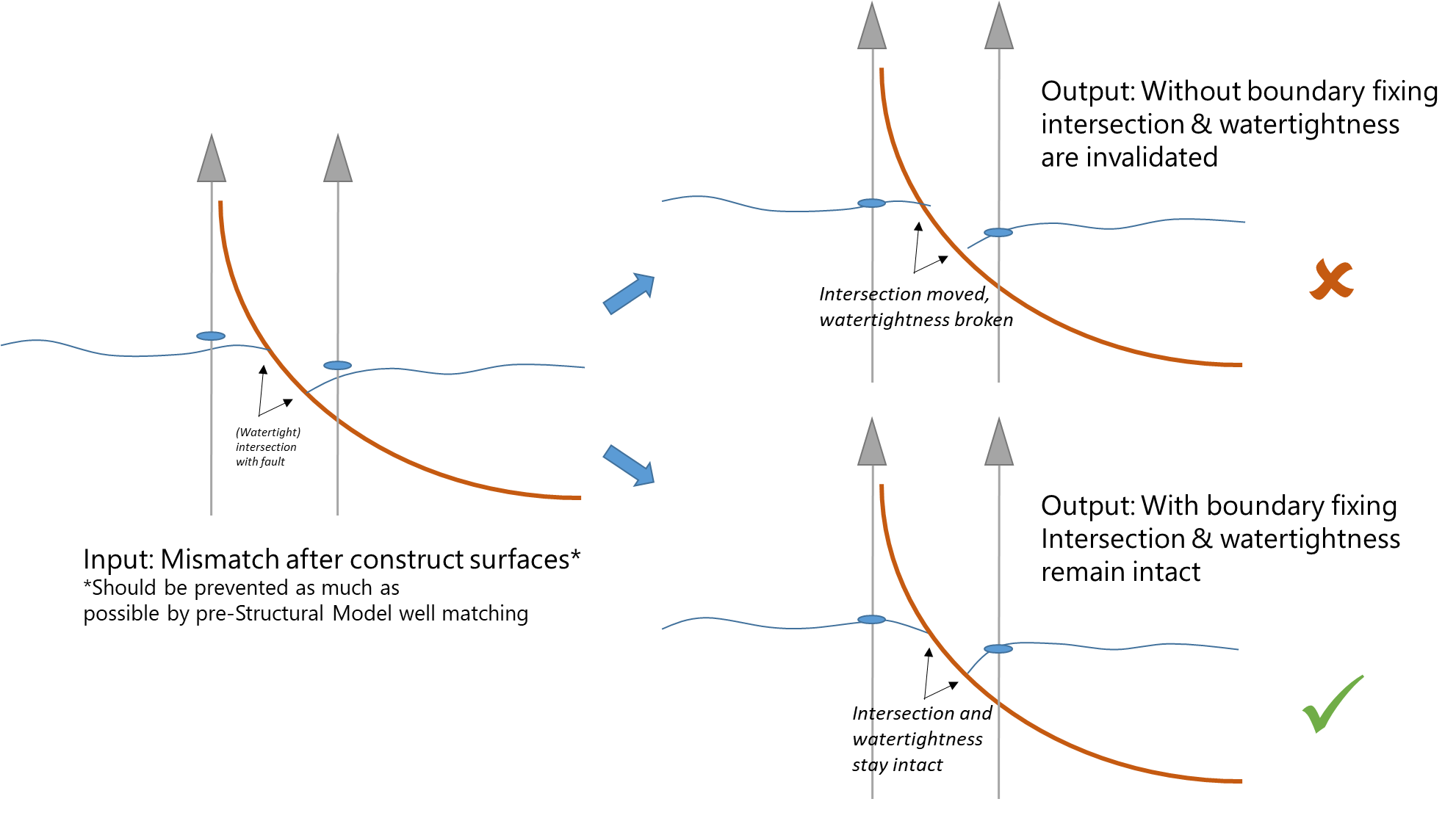
The boundaries of the tri-mesh patches are fixed in place during well matching, ensuring watertightness is retained. click to enlarge
 Step 1 - Specify input data at the top of the form
Model Select the structural model that contains the surfaces that you want to well match. When one or more markers of the marker set assigned to the structural model are excluded from modeling(*), a warning icon appears behind the selection drop-down, see image below. You can ignore the warning if you are deliberately excluding markers.

When not all markers in the selected marker set are included in the modeling, you are warned via the info icon on the form. You can ignore the warning in case you are deliberately excluding one or more markers from your selected marker set. In/excluding markers is done via the 'Use for modeling' column in the Marker Table. click to enlarge
(*) A marker is excluded from modeling when its checkbox 'Use for modeling' is unchecked in the Marker Table. If you want to include the marker in well matching, check its checkbox. If the checkbox in the Marker Table is disabled (grayed-out), this means the entire wellbore is excluded from modeling. First include the wellbore via the wellbore's context menu option 'In Model Data' (right-mouse click on the wellbore in the JewelExplorer), then check the 'Use for modeling' checkbox in the Marker Table, which is now enabled.
Match to
- Marker Set Select this option if you want to match your surfaces only to markers.
- Point Set Select this option if you want to match your surfaces only to point sets.
- Both Select this option if you want to match your surfaces to point sets and to markers. Be aware that you cannot individually select to match Event A to a point set and Event B to a marker set; the well matching will always match to both representations if both are available.
Wellbore(s) (Not applicable when matching to a point set) Select the well group that contains the wells with markers to which you want to match surfaces. The 'Well Data' item in the JewelExplorer is automatically set to 'All wells' (default well group containing all wells). If you do not want to match to all wells in the selected well group, click the pencil behind the drop-down and make a sub-selection of wells in the 'Wellbore selection' dialog that opens.
Maintain surface intersection at wellbore without markers (Not applicable when matching to a point set) With this option the depth of the surfaces at wells with no marker will be retained. If this option is unchecked, the residual interpolation can potentially affect the surface depth at wells with no markers.
Step 2 - Select events, specify interpolation settings and calculate residuals
On the Input tab, the input table shows all the stratigraphic events that are present in the selected 3D Structural Model. The events to match can be horizons, unconformities and intrusions. The 'Match to' column shows whether a marker or point set is available to match to by displaying the respective icon.
Event to Match This column lists all the stratigraphic events in the selected 3D Structural Model. Select the event(s) that you want to depth well match. The tri-mesh representations of the events are checked by default as the 3D Structural Model only contains surfaces with tri-mesh representations. If an event has no data to match to (marker or sparse point set) the event is grayed-out and cannot be selected.
Match to This column responds to the selection under 'Match to' at the top of the form and shows whether the event has markers in the marker set assigned to the Structural Model and/or whether a 'sparse point set' is available. A sparse point set is a point set for which the checkbox 'Point set is Dense' on the Edit Model form is unchecked. Matching to dense point sets (default) is not possible.
Residual Interpolation
With the settings under 'Residual Interpolation' at the right side of the Input tab you specify, per event, how the residuals (once they are calculated) should be interpolated over the modeling area. The residual properties 'WM Residuals Pre' and 'WM Residuals Post', which will be created after 'Calculate' and 'Apply' respectively, are created based on these settings.
Event Select the event of interest in the Input table by clicking on it (it turns blue and a little arrow appears in front of the row). The name of the selected event will be displayed in light gray.
Method Select an interpolation method to construct the surfaces.
Inverse Distance Weighting This method uses the distance-weighted algorithm to interpolate the surface using the input locations as constraining input.
Ordinary Kriging (Legacy) This selection applies the geostatistical Kriging method to interpolate the property across the area. This type of Ordinary Kriging does not make use of the industry standard Kriging library and is performance optimized.
Power This option is only enabled when method Inverse Distance Weighted is selected. The Power is the exponent used for the weighting of the distances. Choose a value between 0.5 and 7.
Function This option is only enabled when Ordinary Kriging is selected. Specify the type of kriging: Exponential, Exponential power, Spherical, or Gaussian.
Major range This option is only enabled when Ordinary Kriging is selected. Specify the major range of influence of the input locations.
Minor range This option is only enabled when Ordinary Kriging is selected. Specify the minor range of influence of the input locations.
Azimuth(GN) This option is only enabled when Ordinary Kriging is selected. Specify the azimuth (to Grid North) of the axis corresponding with the major range.
Power (Ordinary Kriging) This option is only editable when the method is 'Ordinary Kriging' and the function is set to 'Exponential Power'. You can adjust the lateral extent of the kriging. Enter a value between 0 and 2.
Radius of influence Check the box to use a radius of influence and enter a value in the entry field. The radius of influence determines the distance over which you allow the interpolation of the residuals (and ultimately the well matching) to take effect. When matching to markers, the marker is the midpoint of the radius of influence; when matching to point sets (not enabled for well matching faults and 3D mesh structural models), each node of the point set is a midpoint of the radius of influence. When you leave the box unchecked, the interpolation takes effect over the entire modeling area (no limit).
Repeat the above steps for all the events that you selected as input to the well matching. You can right-mouse click on an event and copy-paste the settings to other events.
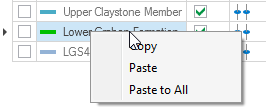
You can copy-paste the residual interpolation settings from one event to the other. click to enlarge
When you have finished the interpolation settings for each of the selected events, click Calculate at the base of the form and continue reading under Step 3 - QC the residuals.
Step 3 - QC the residuals
After clicking 'Calculate' at the base of the form:
- The Residuals tab opens with the calculated residuals displayed in the table. A residual is the TVD difference between the input surface and the marker (or point set). In some cases an info-box may appear in the table cell, or a table cell remains empty. See Info-box and other scenarios in residual table below for explanations of the info-box messages and other special scenarios.
- Per event, a residual property WM Residuals Pre is added to the surface and to the marker (and if a point set was used, to the point set). The property added to the surface is an interpolation of the residual values, based on the settings as specified under Residual Interpolation on the Input tab (Step 2). The name of the property reflects how it was generated: it contains the name of the structural model and representations (marker set and/or point set) used.
- In the Color Settings section on the form, the color scale is automatically scaled to the maximum absolute residual value and the colorset 'S_RedWhiteBlue' is auto-selected. You can change the color set and/or scale at any stage during QC by selecting/typing in the corresponding entry fields and clicking Update Colors.
Info-box and other scenarios in residual table
In some cases, no residual could be calculated, or a residual was calculated under special circumstances. In these cases an info-box with a short description of the issue is shown in the respective table cell. A cell can also remain completely empty, or an event can have multiple residuals in the same well. See below for an overview of all special scenarios that can occur in a table cell.
1)  The cell shows an info-box but does not contain a residual value. The info-box can contain the following messages (note that these messages may occur simultaneously):
- No marker The wellbore does not have a marker for the respective event. This can also happen when the wellbore intersects the surface multiple times but not each intersection has a corresponding marker (see image A below).
- No intersection The wellbore does not intersect the surface of the respective event. Most probably the wellbore is located outside of the outer edge of the surface.
- Marker excluded via 'Use for modeling' The marker is not included in well matching as the 'Use for modeling' checkbox in the Marker Table is not checked.
- Wellbore excluded via 'In model data' The marker is not included in well matching as the 'In model data' option on the well's context menu is switched off. When 'In model data' is switched off, all markers of that wellbore are automatically excluded (grayed-out) in the 'Use for modeling' column of the Marker Table.
- Marker depth not defined The marker exists in the Marker Table but its MD depth is not defined.
- Cause unknown Another cause than the ones mentioned above has prevented the application from calculating a residual.
2)  The cell shows an info-box and contains a residual value. This means the residual was calculated under a special circumstance. The following message may occur:
- No intersection A marker is present for the wellbore but the wellbore does not intersect the corresponding surface due to the fact that the TD (total depth) of the wellbore is shallower than the surface. The residual is calculated via projection of marker on the surface (see image B below).
Special scenarios with no info-box in the cell
The following special scenarios can occur while no info-box is shown in the cell.
3)  The cell is empty (no value and no info-box). This is not related to any modeling issue but due to the arrangement of residual data in table format. More specifically, a cell may remain empty when:
- Another event has multiple markers.
- One event has only point set data, while another event has only marker data.
4)  There are multiple markers for one surface intersection. The application calculates the residuals for all these markers. In case you would proceed with the well matching, the application uses the marker closest to the surface (the other markers are ignored). The post residual property will show zero-residual for the used (closest) marker while the other markers keep a residual. Note that a horizontal well with multiple markers (one marker at each surface intersection) is a valid scenario. It is therefore recommended to always check the wellbore and markers when multiple residuals for one event exist.
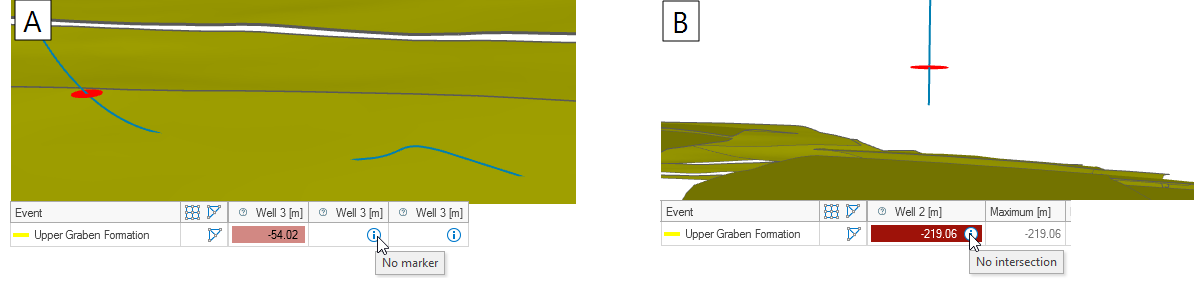
Image A: The wellbore intersects the surface three times but only one corresponding marker is detected. The other two intersections receive a 'No marker' message in the residual table. Image B: A corresponding surface and marker are detected, however, the wellbore does not intersect the surface. The marker is projected onto the surface and the residual is calculated anyhow (with an info-box warning displayed next to the residual in the table). click to enlarge
Before you perform the well matching it is important to review the residuals to assess whether they are acceptable. There are two ways to QC the residuals: via the table on the form and by displaying the residual property 'WM Residual Pre' in the dedicated Well Matching Residual View.
QC residuals using the table
The following table filter options are available:
Hide wellbores and representations when all their associated (absolute) residuals are smaller than When the residuals table is very full, you can use this option to reduce the number of wells and/or surfaces shown in the table in order to focus on large residuals. You do this by entering a residual value in the entry field: when all residuals of a surface, a wellbore or point set are smaller than this value, the surface/wellbore/point set will be hidden in the table.
Show residuals This option is only available when you have already applied your well matching and you have pre-well matching and post-well matching residuals. Select Post Well Matching if you want to display the remaining residuals after well matching; select Pre Well Matching if you want to display the residuals prior to well matching.
Arrangement This option determines the row/column arrangement of the table. The default selection By Representation places the events in rows and the wellbores and/or point sets in columns. Selecting By Wellbore places the wellbores and/or point sets in rows and the events in columns.
QC residuals using a property in a dedicated view
The 'WM Residual Pre' property shows you how much the surface will shift as a result of well matching. It is recommended to review this property in the dedicated Well Matching Residual View before carrying out the well matching. By visualizing this property in the dedicated view, you can see the full effect of the well matching on the entire surface.
To open the view, click in a cell in the residuals table. The objects displayed in the view depend on the clicked cell:
- Clicking on a cell with a residual value displays the corresponding marker-surface (or point set-surface) combination in close-up view.
- When the arrangement is 'By Representation', clicking in the same row (but not on a residual value) displays the residual together with all wells and markers corresponding to the event (when matching to markers) or no wells at all (when matching with point sets).
You can make changes to the input and re-calculate the residuals based on updated settings. For example you can in- or exclude more wells or markers, update the interpolation settings, etc. Each time you click Calculate, the residual property is overwritten.
Once you are satisfied with the suggested surface correction, move to 'Step 4 - Well match the surface'.
Step 4 - Well match the surface
Click Apply at the base of the form to apply the well matching and keep the form open, or click OK to apply the well matching and close the form. Upon clicking:
- The input surface is overwritten with the well matched (output) surface.
- Per event, a post well matching residual is calculated and displayed in the table. The post residual is the TVD difference between the well matched surface and the marker (or point set).
- Residual property WM Residual Post is added to the surface and to the marker (and if a point set was used, to the point set). The property added to the surface is an interpolation of the residual values, based on the settings as specified under Residual Interpolation on the Input tab (Step 2). The name of the property reflects its origin (it contains the structural model name and representations used).
Visualize property WM Residuals Post in the dedicated Well Matching Residual View by clicking in a cell in the table on the form. Under normal circumstances this property shows (near) zero values at all output surface locations. At locations where the post well matching property is not zero, this means the well matched (output) surface could not honor all input data (i.e. the markers, point set data, or both).
Exporting residual data
The 'Export residual data to CSV' option ( ) located at the upper-right side of the residual table, lets you export your pre and post well matching residuals in CSV format. All residual data that has been calculated (or applied) is gathered in the export, irrespective of any filters applied to the table on the form.
Exported data also includes the 'angle of incidence' per calculated marker residual (not applicable when well matching to a point set): the 'pre well matching angle of incidence' is the smallest angle between the wellbore and the input surface, the 'post well matching angle of incidence' is the smallest angle between the wellbore and the well matched surface.
To export the data
- Click the 'Export residual data to CSV' icon.
- From the Export to... dialog that opens, save the CSV file at your preferred location.
- The file contains the following data:
- Per wellbore the 'pre well matching' residuals and (if well matching was performed) also the 'post well matching' residuals, including their combined statistics (min, max, mean, median and standard deviation).
- Per residual the 'angle of incidence'. The 'pre angle of incidence' is the smallest angle between the wellbore and the input surface, the 'post angle of incidence' is the smallest angle between the wellbore and the well matched surface.
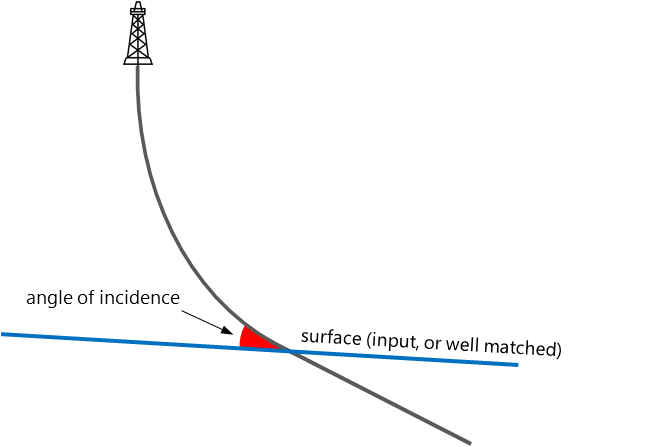
The angle of incidence, which is exported alongside the residuals in the CSV file, is the smallest angle between the wellbore and the surface. click to enlarge
Creating a point set from all residual data (only for marker residuals)
With the 'Create point set(s) (in Data folder) with all marker residual data' option ( ) located at the upper-right side of the residual table you can create, per surface, a point set from marker residuals. The nodes of the point set represent the marker locations, the residuals (pre and post well matching) are stored as properties of the point set. Using point sets to store your well matching results allows you to create extra copies of your well matching actions (for reporting purposes) and to perform advanced analysis of the residuals (trends, scatter plots) and the angle of incidence.
The point set is stored in the Data folder under the respective event type (Horizons, Faults, Unconformities, etc). The point set name is assembled as follows:
Event name_WMResults (Structural Model name, Structural Model name, Marker set): Input representation
To create the point set(s)
- Click the 'Create point set(s) (in Data folder) with all marker residual data' icon.
- Verify that per event, a point set is created in the JewelExplorer > Data folder, under the respective event type (Horizons, Unconformities or Intrusions).
-
The point set contains the following properties:
- Depth (default)
- WM Residual Pre
- (Optionally) WM Residual Post
- Wellbore Names
- WM Angle of Incidence Pre(*)
- WM Angle of Incidence Post (if you applied the well matching with 'Apply' or 'OK' on the form)
(*) See explanation of this angle under 'Exporting residual data' above.
- Visualize the point set and property of your choice in the 3D View by checking the boxes in the JewelExplorer.